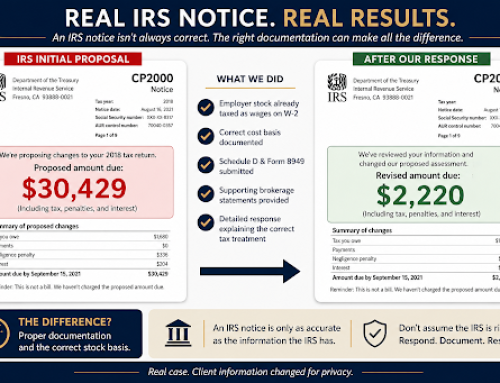

If you’re one of the millions of Americans living paycheck to paycheck, opening a CP2000 notice from the IRS and learning that you may owe thousands of dollars in additional taxes can be very stressful. It’s natural to feel overwhelmed when faced with a large proposed tax bill. Many taxpayers assume that because the notice comes from the IRS, the amount must be correct. In reality, that is not always the case. Do NOT panic! An experienced CPA can help you with this situation.
Keep reading to see two case studies, top seven triggers for a CP2000 notice, and six things to review when responding to a CP2000 notice.
What IS A CP2000 Notice?
A CP2000 notice is a proposed adjustment generated by IRS matching systems when information reported to the IRS does not match the information reported on a tax return. While some notices are valid, many are generated automatically and may not include all relevant facts, documents, or explanations.
A CP2000 notice is typically issued when the IRS receives income information from third parties – such as employers, banks, brokerage firms, retirement custodians, or payment processors – that does not appear to match the amounts reported on a tax return.
Common triggers include:
A CP2000 notice is not technically a formal audit. It is a proposed adjustment.
That distinction is important. It is, by any means, NOT an audit so we can work with IRS to correct errors.
- Here is How CP2000 Notice Looks Like:
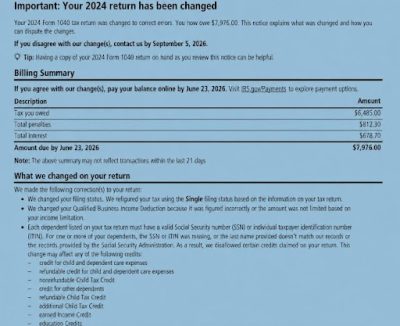
Example of CP2000 Notice From IRS
The IRS May Not Have the Full Picture
Many taxpayers assume:
“If the IRS sent the notice, they must already know everything.”
That is often not true.
IRS matching systems primarily compare numbers reported by third parties against numbers reported on the return. Those systems frequently do not account for:
In many situations, the IRS simply sees incomplete data.
A Real-World Example – Case Study #1: Incorrect Applications of Payments
In one recent matter handled by our office, a California business taxpayer received a tax notice showing an additional balance due of nearly $7,000 after the taxing authority reduced estimated tax payments reported on the return.
However, after carefully reviewing the notice, account history, payment confirmations, and bank records, it became clear that the payments had actually been made and reflected in the taxing authority’s OWN online records. So the notice generated by tax authorities in this case California FTB did not match their own records!
The issue appeared to result from incorrect application of payments and inconsistencies in the notice calculations. Once the records were reconciled and supporting documentation provided, the proposed balance was disputed successfully!
Situations like this are more common than many taxpayers realize due to atomization of notice processes by tax authorities
Tax notices are frequently generated automatically, and mistakes involving estimated payments, transposed figures, missing credits, or incomplete reporting can and do occur.
Another Real-World Example – Case Study #2: Withholding Verification Mismatches
In another matter handled by our office, a taxpayer received a California balance due notice for more than $3,300 after the Franchise Tax Board reduced the California withholding claimed on the filed tax return.
However, after reviewing the taxpayer’s W-2 forms and supporting documentation, it became clear that the withholding amounts reported on the original return were fully supported by employer-issued W-2s.
The issue appeared to stem from an employer reporting mismatch or incomplete verification within the state’s records system rather than an actual error on the filed return.
Once the W-2 documentation was provided and reconciled against the notice calculations, the proposed assessment was disputed successfully.
Situations like this demonstrate why taxpayers should not automatically assume that every IRS or state tax notice is correct. Automated matching systems may rely on incomplete, delayed, or mismatched information, which can sometimes generate incorrect balances due.
Common CP2000 Situations My CPA Practice In Woodland Hills, CA Has Seen
Brokerage Accounts-related CP2000 Notices
One of the most common CP2000 situations involves stock sales where the IRS receives the gross sales proceeds but not the taxpayer’s cost basis information.
As a result, the IRS system may incorrectly assume the entire sales amount is taxable gain.
For example:
• Stock sold for $100,000
• Original purchase price was $95,000
• Actual gain was only $5,000
If cost basis information is missing, the IRS may initially calculate tax as if the taxpayer made $100,000 in profit.
Cryptocurrency Reporting Often Triggers CP2000 Notices
Cryptocurrency reporting frequently triggers automated notices because exchanges may report transaction activity differently than taxpayers expect.
Transfers between wallets, basis tracking issues, and incomplete reporting often create discrepancies that require explanation.
Retirement Rollovers Can Be Treated As Taxable Income
Another common issue occurs when retirement funds are rolled from one account to another.
The IRS may receive a Form 1099-R showing a large distribution, but if the rollover reporting was incomplete or mismatched, the IRS system may incorrectly treat the transaction as taxable income.
Do Not Ignore the CP2000 Notice
CP2000 notices should NOT be ignored.These notices contain response deadlines, and failure to respond may result in the IRS assessing the proposed tax automatically along with additional penalties and interest.
Do Not Automatically Agree With the CP2000 Notice Either
One of the biggest mistakes taxpayers make is immediately paying a proposed balance without reviewing the underlying calculations.
A CP2000 notice should be carefully analyzed to determine whether:
In many situations, the proposed balance may be reduced substantially or eliminated entirely after proper review.
Get a Professional CPA Review – This Can Be Critical To Your Success
CP2000 notices often involve detailed tax reporting issues that require review of transcripts, brokerage statements, prior returns, payment histories, and supporting records.
Each case is different, and the correct response depends on the underlying facts.
Need assistance with a CP2000 notice, IRS correspondence, or tax dispute?
Donckels CPA assists individuals and businesses throughout California and the United States with IRS notices, amended returns, tax compliance matters, and representation before taxing authorities.
This article is intended for general informational purposes only and should not be considered tax advice. Every taxpayer’s situation is unique and should be reviewed individually.