
One of the biggest misconceptions I hear is:
“If the IRS sent a notice, it must be correct.”
Not necessarily.
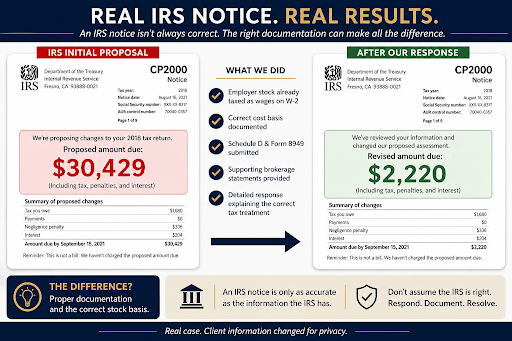
I recently worked on a case involving an IRS CP2000 Notice where the IRS initially proposed that my client owed more than$30,000 in additional tax, penalties, and interest.
That number certainly gets your attention.
But after carefully reviewing the documents, it became clear that the IRS did not have the complete picture.
The Problem
My client had received restricted stock units (RSUs/PSUs) from his employer.
When those shares vested, the value of the stock had already been reported as taxable wages on his W-2, and payroll taxes had already been withheld.
Later, when some of those shares were sold, the brokerage issued Form 1099-B reporting the sales proceeds.
Here’s where many IRS notices begin.
The IRS receives the 1099-B showing the sales price – but it doesn’t always receive the correct cost basis for employer stock.
If the basis is missing, the IRS may assume the basis is zero, making it appear as though the entire sales price is taxable gain.
That wasn’t what actually happened in this case.
Looking Beyond the IRS Notice
Instead of simply accepting the proposed changes, we gathered the supporting documentation, including:
- W-2 showing the stock compensation had already been taxed as wages
- Employer stock compensation statements
- Supplemental brokerage statements showing the correct cost basis
- Form 8949
- Schedule D
- Additional documentation explaining the transaction history
We submitted a detailed response explaining why the IRS calculation overstated the taxable gain and requested that the tax be recalculated using the correct basis.
Sometimes One Response Isn’t Enough
Many taxpayers assume that once they respond, the matter is over.
In reality, the IRS may ask for additional documentation.
In this case, the IRS later requested Schedule D and Form 8949 before adjusting the account.
We provided everything requested but didnot agree to sign a consent accepting the original proposed assessment because it still reflected an incorrect calculation. Instead, we explained why the original amount remained inaccurate and asked the IRS to recalculate the tax correctly.
The Result
The original proposed assessment exceeded$30,000.
After the IRS reviewed the additional documentation and considered the stock basis, the proposed balance was reduced dramatically to approximately$2,220, including tax, penalties, and interest.
While every case is different and no outcome can ever be guaranteed, this case demonstrates an important lesson:
An IRS notice is only as accurate as the information the IRS has available.
The Takeaway
Receiving an IRS notice does not automatically mean you owe the amount shown.
Many notices are generated automatically by matching information returns, and sometimes important details such as stock basis, corrected forms, depreciation, or other adjustments are missing.
Before paying thousands of dollars, make sure the notice is reviewed carefully.
I’ve seen many situations where a detailed analysis and proper supporting documentation made a significant difference.
If you’ve received an IRS CP2000 or another tax notice, don’t panic – but don’t ignore it either. Understandingwhy the IRS made the adjustment is often the first step toward resolving the issue. This is where your CPA can help you.