

I Formed an S Corporation. Why Am I Still Paying Taxes Personally?
One of my new clients recently asked me several great questions after forming her first S corporation.
She asked:
- Do I need to make estimated tax payments?
- How much salary should I pay myself?
- Should the corporation pay the taxes?
- How much money should I transfer to my personal account?
These are excellent questions because many people assume that once they form an S corporation, the corporation pays the income tax.
It doesn’t. And that’s the advantage of an S corporation vs C Crorporation
An S Corporation Is Usually a “Pass-Through” Entity
One of the biggest advantages of an S corporation is that the corporation generally doesnot pay federal income tax.
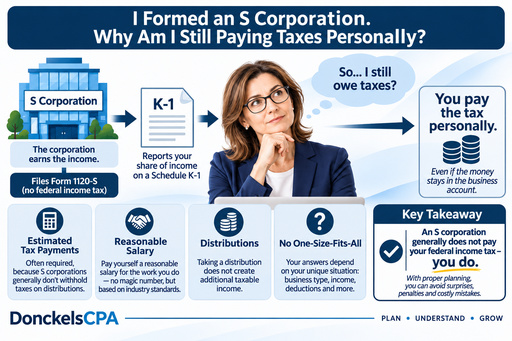
Instead, the corporation files its own tax return (Form 1120-S), calculates its taxable income, and reports each shareholder’s share of that income on a Schedule K-1.
That income then flows through to the shareholder’s personal tax return.
In other words:
The corporation earns the income.
The shareholder pays the tax.
Even if the money stays in the business bank account.
This surprises many new business owners.
“But I Didn’t Take the Money…” – one of my client told me.
“I left it all in the corporation and lived on my savings.”
Another common misunderstanding is believing that taxes are only due after money is transferred from the business account.
Unfortunately, that’s not how it works.
For an S corporation, taxable income is generally reported to the shareholder whether or not it has actually been distributed. And then distribution are however distributed tax free
You could leave every dollar in the corporate bank account and still owe income tax personally.
This is why proper tax planning is so important.
What About Distributions?
Many people ask me:
“How much should I transfer from the business account to my personal account?”
There isn’t one magic percentage.
Every business is different.
Some business owners leave cash in the company for future expenses.
Others distribute more because they need the funds personally.
The important thing to understand is thattaking a distribution does not, by itself, create taxable income.
The taxable income has already been determined by the corporation’s profits.
What Is a Reasonable Salary?
This is another area that causes confusion.
The IRS requires shareholder-employees who perform services for their S corporation to receivereasonable compensation before taking distributions.
There is no fixed percentage and no IRS formula.
The appropriate salary depends on many factors, including:
- The type of business
- Duties performed
- Experience
- Time devoted to the business
- Industry standards
- What someone else would reasonably be paid to perform similar work
Choosing a salary simply because it “sounds right” can create problems if the IRS later determines it was unreasonably low.
Do I Need Estimated Tax Payments?
Often, yes.
Because S corporations generally do not withhold federal income tax from distributions, many shareholders must make quarterly estimated tax payments personally.
Waiting until tax season can result in underpayment penalties and interest.
Estimated payments are usually made directly by the shareholder—not by the S corporation.
Every Situation Is Different
There is no one-size-fits-all answer to questions like:
- “How much salary should I pay myself?”
- “How much should I distribute?”
- “How much should I save for taxes?”
The answers depend on your total income, other sources of income, deductions, filing status, state taxes, payroll taxes, and many other factors.
What works perfectly for one business owner may be completely wrong for another.
Final Thoughts
Forming an S corporation can provide valuable tax benefits, but it also creates new responsibilities and new rules.
One of the most important things to understand is this:
An S corporation generally does not pay your federal income tax – you do.
Understanding how reasonable compensation, distributions, and estimated tax payments work together can help you avoid surprises, penalties, and costly mistakes.
A little planning throughout the year is often much less expensive than fixing problems after the fact.
One of the things I enjoy most about working with new business owners is helping them understand how all of these pieces fit together. Tax law can seem overwhelming at first, but once you understand the basic concepts, everything starts to make much more sense. Asking questions isn’t a sign that you don’t know enough – it’s how you avoid expensive mistakes.
Katerina Donckels, CPA, EA
Katerina Donckels CPA Inc.
Tax Preparation | IRS Representation | Business Accounting